

New to Cars? Here's What to Do When Your Check Engine Light Comes On in Hollywood, FL
New to driving? If your check engine light comes on, don't panic. Start by checking whether the light is steady or flashing, and pay attention to any unusual noises, rough idling, or changes in performance. A flashing light or serious engine symptoms may require you to stop safely and seek immediate assistance. At CM Auto Repair, our experienced technicians use OBD-II diagnostic scans and professional testing to identify the cause of the warning light, explain your repair options, and help you keep your vehicle running safely and reliably.
What the Check Engine Light Means
The check engine light means your car's computer spotted something outside normal range and stored a trouble code. It's a message, not a verdict. A steady light means get it checked soon, while a flashing light means stop driving and get help now.
New to cars? Here's what to do when your check engine light comes on: don't panic, and don't ignore it either. That little orange engine symbol isn't your car giving up. It's your car talking.
Every car built since 1996 has an onboard computer. It watches dozens of sensors all day long. Fuel mix, air flow, spark timing, exhaust readings. When one of those readings drifts outside the normal range, the computer saves a trouble code and flips the light on. That's the whole system in one sentence. JD Power has a deeper in-depth guide to how a diagnostic test works [1].
The code doesn't tell you the repair. It tells you the symptom. Big difference.
We see this mistake all the time. Someone reads a code at a parts counter, buys the part the code names, swaps it in, and the light comes right back. The code pointed at a sensor, but the sensor was just reporting bad news from somewhere else. That's why a real Check Engine Light Diagnosis matters more than a free code read.
So what sets it off? The list is long, but the common stuff repeats over and over.
-
A loose or cracked gas cap letting fuel vapor escape
-
A worn oxygen sensor reading the exhaust wrong
-
Bad spark plugs or ignition coils causing a misfire
-
A dirty or failing mass airflow sensor
-
A catalytic converter that's losing efficiency
Notice how the first item is a two-dollar fix and the last one is a serious repair. Same light. That's the frustrating part for new owners, and it's exactly why guessing is expensive.
A steady light and a flashing light are not the same message. Steady means the computer found a fault and wants it looked at. You can usually keep driving, just get it scanned soon. Flashing means a misfire is dumping raw fuel into your exhaust right now, and that can wreck the catalytic converter in minutes. Pull over when it's safe. Flashing is the emergency version.
When the light shows up, work through these steps in order:
-
Check if the light is steady or flashing.
-
Notice how the car feels. Rough idle, loss of power, odd smells, strange noises.
-
Tighten the gas cap until it clicks, then drive a day or two.
-
If the light stays on, get an OBD-II Diagnostic Scan done.
-
Have a tech confirm the cause before any part gets replaced.
One more Hollywood-specific note. Stop-and-go traffic on Highland and Sunset is brutal on engines. Lots of idling, lots of heat, short trips that never let the engine fully warm up. Those conditions age sensors and spark plugs faster than open highway miles. So if your light pops on and you mostly drive across town, that's normal wear showing up, not bad luck.
Your car found a problem and told you about it. Most people don't realize that's the best-case scenario, the alternative is finding out when something breaks on the 101.

Blinking vs. Steady: Why the Pattern Changes Your Next Move
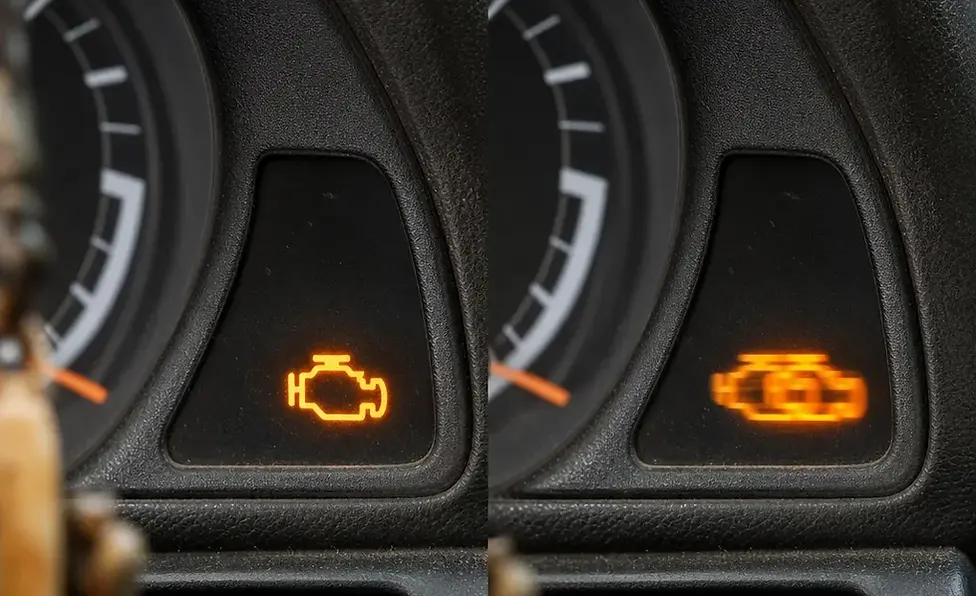
Here's the one thing worth memorizing. A steady light means to schedule it. A blinking light means stop driving.
That's it. That's the whole rule. Most new drivers panic the same amount either way, but your car is giving you two very different messages. A steady glow usually points to something the computer noticed and stored in memory. Could be a lazy oxygen sensor, a small vacuum leak, or a gas cap that didn't click. The engine still runs fine, you still have brakes, you can still get to work.
A flashing light is a different animal. It almost always means raw fuel is dumping into your exhaust system because a cylinder isn't firing right. And raw fuel plus a hot catalytic converter is how a $200 repair turns into a $1,500 one. We see this all the time, someone drives a misfire across town because the car "still moves." It moves right up until the converter melts.
So what do you do in the moment? Follow this order.
-
Look at the light. Is it holding steady or pulsing on and off?
-
If it's flashing, ease off the gas and get out of traffic safely.
-
Find the nearest lot, side street, or shoulder and shut the engine off.
-
Listen and feel. Rough idle, shaking, loss of power, or a fuel smell means don't restart it for a long drive.
-
Call for a tow or a ride instead of pushing your luck on the 101.
-
If it's steady and the car feels normal, check your gas cap and keep driving gently.
-
Book a Check Engine Light Diagnosis within the next few days so the code doesn't stack up with others.
Picture this. You're heading up Highland toward Franklin during rush hour and the light starts blinking. The temptation is to just make it home. But a stop-and-go crawl is the worst place for a misfiring engine, heat builds and there's no airflow to help. Pulling into a side street off Hollywood Boulevard and shutting it down is the cheaper decision every single time.
Steady light, but something still feels off? Trust the feeling over the light. Pull over if you notice any of these.
-
The temperature gauge climbing toward the red zone
-
Loud knocking, ticking, or grinding you haven't heard before
-
Smoke or steam from under the hood
-
A strong smell of gas, burning oil, or rotten eggs
-
The car hesitating, surging, or stalling at stoplights
-
Any second warning light joining the party, especially oil or battery
That last one matters more than people think. One light is information. Two lights together usually means a real mechanical problem, not a sensor having a bad day.
And a quick note on something new owners always ask us. A light that comes on, goes off, then comes back a week later isn't fixed. The computer just stopped seeing the fault for a few drive cycles. The stored code is still in there, waiting.
Is It Safe to Keep Driving? A Scenario-Based Guide
Here's the question everyone asks first. Can I just keep driving? Sometimes yes. Sometimes absolutely not. The answer depends on what the light is doing and what the car feels like underneath you.
Let's walk through it the way I'd walk a friend through it on the phone.
Scenario one. The light comes on steady. Car drives normal, no weird sounds, no smells, temperature gauge sitting where it always sits. You're fine to finish your drive. Get it scanned within a few days, though. A steady light means the computer logged a fault, it doesn't mean the fault is small. We see people drive around with a steady light for eight months and then wonder why the repair got expensive.
Scenario two. The light is flashing. Pull over when it's safe and shut the engine off. A flashing check engine light usually means raw fuel is dumping into your exhaust. That cooks the catalytic converter fast. You can turn a cheap coil pack job into a converter replacement in about twenty minutes of freeway driving. Not worth it.
Scenario three. Steady light plus something else feels off. Rough idle at a stoplight. Hesitation when you press the gas. Bucking on the on-ramp. This one's a drive-straight-to-the-shop situation, not a next-week situation. The car's telling you twice.
Scenario four, and this is the one nobody expects. Light on plus the temp gauge climbing, or steam, or a burning smell. Stop. That's not a check engine problem anymore, that's an overheating problem riding along with one. Driving an overheating engine is how head gaskets die.
Use this quick sequence when the light shows up:
-
Look at the light. Flashing or steady?
-
If flashing, pull over safely and shut it off.
-
If steady, check your gauges. Temperature and oil pressure normal?
-
Notice how the car drives. Any shaking, hesitation, or new noise?
-
Check your gas cap at the next stop. Tighten it until it clicks.
-
If everything feels normal, book a Check Engine Light Diagnosis within a few days.
-
If anything feels wrong, drive to a shop now or call for a tow.
Hollywood driving makes this worse in one specific way. Stop-and-go traffic on Sunset and Highland means your engine runs hot and idles a lot. A misfire that feels mild on a quiet street gets ugly when you're crawling in traffic for forty minutes. Heat is the multiplier here.
And one more thing new owners get wrong. A light that turns itself off doesn't mean the problem is gone. The code is still stored in the computer. It'll come back, usually at a worse time.
Frequently Asked Questions
Can I still drive with the check engine light on?
You can usually keep driving if the light is steady and the car feels normal, but you should get it checked soon. A steady light means the computer stored a code, not that something is failing right now. If the light is flashing, stop driving right away. That pattern means a misfire is happening, and it can damage your catalytic converter in minutes. When in doubt, treat any weird noise, smell, or power loss as a reason to pull over.
Why does my check engine light keep coming back after it turns off?
A light that goes off and returns isn't fixed, it just stopped showing up for a few drive cycles. The trouble code is still stored in the computer, waiting. This confuses a lot of new car owners because the car seems fine in between. The real fix is getting the original cause diagnosed instead of waiting to see if it happens again. A proper Check Engine Light Diagnosis finds the actual source instead of guessing.
Does a check engine code tell you exactly what part to replace?
No, a trouble code points to a symptom, not the repair. This is the biggest misconception new drivers have about their check engine light. A code might name a sensor, but that sensor could just be reporting a problem coming from somewhere else in the engine. Swapping the named part often doesn't fix anything and the light comes right back. That's why a full diagnostic scan matters more than a quick code read at a parts counter.
Does Hollywood traffic make check engine lights come on more often?
Yes, stop-and-go traffic on streets like Highland and Sunset is hard on your engine. Constant idling and short trips create heat without letting the engine fully warm up or cool down properly. This wears out sensors and spark plugs faster than steady highway driving. If your light comes on and you mostly drive across town, that's normal wear catching up with you, not bad luck. It's a good reason to get things checked regularly if you drive Hollywood streets daily.
What's the difference between a loose gas cap and a serious engine problem?
A loose gas cap triggers the same light as a serious problem, but the car will feel completely normal. If your only symptom is the light, tighten the cap until it clicks and drive a day or two to see if it clears. If the light stays on, or the car idles rough, loses power, or smells odd, something bigger is going on. That's the moment to book a Check Engine Light Diagnosis instead of guessing at parts.
Should I worry if a second warning light comes on with the check engine light?
Yes, two lights together usually mean a real mechanical issue, not just a sensor problem. One light on its own is often just information the computer wants you to look at. But if the oil light or battery light joins the check engine light, that's a stronger warning. Pull over when it's safe and avoid long drives until a tech looks at it. Catching this early protects your engine from bigger, more expensive damage down the road.