

Brake Fluid Flush in Hollywood, FL
Clean and properly maintained brake fluid is essential for safe and responsive braking performance. At CM Auto Repair in Hollywood, FL, we provide professional brake fluid flush services to remove old, contaminated fluid and help protect your braking system. Our skilled technicians inspect your brake fluid condition and perform a complete flush to improve brake reliability, maintain system efficiency, and keep your vehicle performing safely on the road.
Why Brake Fluid Breaks Down Faster in South Florida's Climate
Hollywood's heat and humidity aren't just uncomfortable. They're actively working against your brake fluid every day.
Brake fluid is hygroscopic. That's a technical word for one simple thing: it absorbs moisture from the air. In South Florida, there's a lot of air moisture to absorb. We're talking about a climate where humidity regularly sits above 80 percent for months at a time. That's not normal wear. That's accelerated breakdown, and we see the results of it constantly.
Here's what actually happens. As moisture gets into your brake fluid, it lowers the boiling point. Fresh brake fluid boils at a high temperature. Moisture-contaminated fluid boils much lower. When you're sitting in stop-and-go traffic on US-1 through downtown Hollywood on a 92-degree afternoon, your brakes are generating serious heat. If your fluid's boiling point has already dropped, that heat can vaporize the fluid in your lines. Vapor doesn't compress the same way liquid does. Your pedal goes soft, or worse, it goes to the floor.
The National Highway Traffic Safety Administration lists brake system failure accounting for 22% of all vehicle related crashes; the second most common reason for accidents [1]. Degraded fluid is a direct path to that failure.
Areas near Hollywood Beach and the Intracoastal tend to see even faster fluid degradation. Salt air adds another layer of corrosion risk to brake lines and calipers. We pull vehicles in regularly where the fluid has turned dark and smells burnt, and the owner had no idea anything was wrong.
A few things that speed up brake fluid breakdown in this climate:
-
High ambient humidity accelerating moisture absorption year-round
-
Extended heat exposure from long summers and direct sun on dark pavement
-
Frequent short trips that heat brakes without fully cooling them down
-
Salt air near coastal areas corroding brake components from the outside in
Most vehicle manufacturers recommend a brake fluid flush about every two years. In Hollywood's climate, that two-year mark can come early. If your fluid looks dark or you haven't touched it in a while, don't wait for a soft pedal to tell you something's wrong.

Clear Warning Signs Your Brake Fluid Needs Replacing
Most drivers in Hollywood don't think about brake fluid until something feels wrong. By then, the fluid has usually been degraded for months.
Here's what to watch for. These signs show up in everyday driving, and we see them constantly at our shop.
-
Soft or spongy brake pedal that sinks lower than usual
-
Pedal that feels inconsistent, firm one day and mushy the next
-
Longer stopping distances, especially in stop-and-go traffic
-
A burning smell after hard braking on the highway
-
ABS warning light or brake warning light on your dash
That spongy pedal feeling is the one we hear about most. You press down and it just doesn't feel right, like there's air somewhere in the line. When the fluid has absorbed too much moisture, it's time for a brake fluid flush.
Brake fluid is hygroscopic. It pulls moisture out of the air over time and can't help it. Once water gets into the system, the boiling point drops. Push your brakes hard coming down a ramp near the Oakwood neighborhood and that degraded fluid can vaporize. Vapor compresses. Fluid doesn't. That's how you lose pedal pressure when you need it most. Brake system failures are among the top mechanical causes of vehicle crashes, according to the National Highway Traffic Safety Administration. Fresh, clean fluid is one of the simplest ways to keep your system working right.
Color matters too. New brake fluid is nearly clear or light yellow. Pull the cap off your reservoir and take a look. If it's dark brown or black, that fluid has been in there way too long. We check this during every inspection because most people have never looked at it themselves.
And sometimes there are no obvious symptoms at all. The fluid just quietly degrades over two to three years of normal Hollywood driving. That's why mileage and time matter just as much as how the pedal feels. Visit our brake repair and service page to see everything we handle for your brake system.
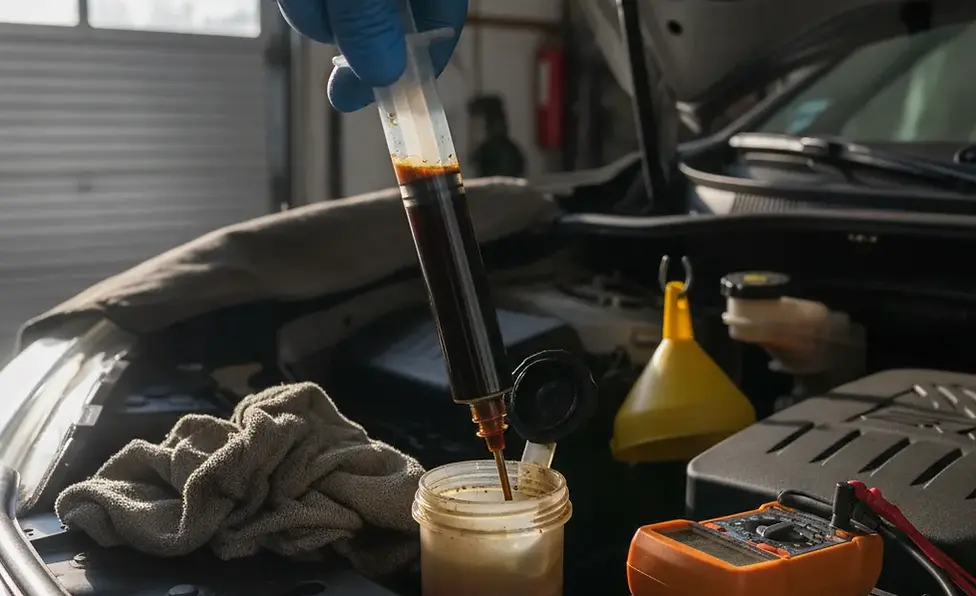
What a Professional Brake Fluid Flush Actually Involves
A lot of people think this is a quick drain-and-fill job. It's not.
When our team does a brake fluid flush in Hollywood, we're not just topping off a reservoir. We're removing the old, moisture-saturated fluid from every part of the brake system and replacing it with fresh fluid that actually does its job. The difference matters every time you press that pedal.
Here's what the process looks like from start to finish:
-
We check the current fluid condition using a test strip or moisture meter. Brake fluid absorbs water over time, and wet fluid has a lower boiling point.
-
We locate all four brake bleeder valves, one at each wheel.
-
We attach a pressure bleeder or use a two-person hand-pump method to push fresh fluid through the system.
-
We open each bleeder valve in sequence, usually starting farthest from the master cylinder, and let the old fluid purge out completely.
-
We close each valve, top off the reservoir, and verify there's no air in the lines.
Air in the brake lines causes a spongy pedal, and a spongy pedal in stop-and-go traffic near the Hollywood/Highland area is not something you want to discover at the wrong moment.
We see this regularly: someone comes in thinking they need new brake pads, but the real problem is degraded fluid. The pedal feels soft, the braking feels inconsistent, and the fix is a flush, not new hardware. Brake system failures rank among the most common mechanical causes of vehicle accidents, a fact the National Highway Traffic Safety Administration has documented repeatedly.
The whole service takes about 30 minutes to an hour. But we don't rush it.
We also do a visual check on the calipers and lines while we're in there. Not because it adds to the bill, but because we'd rather tell you now than have you come back with a bigger problem.
EVs, Hybrids, and the Brake Fluid Myth Most Hollywood Drivers Get Wrong
e hear this one constantly. Someone drives a Prius or a hybrid SUV through Hollywood and figures they don't need a brake fluid flush because regenerative braking does most of the work. Makes sense on the surface. But it's wrong, and it can cost you.
Here's the thing about regenerative braking. Yes, it reduces how often your friction brakes fire. But your hydraulic brake system is still there. The calipers, the lines, the master cylinder, all of it still holds brake fluid. And that fluid still absorbs moisture over time, no matter how rarely you use your physical brakes.
Moisture is the real problem. Brake fluid is hygroscopic, which means it pulls water in from the surrounding air. The Department of Transportation has documented how water contamination drops the boiling point of brake fluid dramatically. On a hybrid, your friction brakes tend to engage hard in emergency stops and steep downhill situations, exactly when you need that fluid performing at full strength. That's not the moment to find out your fluid has gone soft.
What's Different for EV and Hybrid Owners
A few things actually make brake fluid maintenance trickier on hybrids and EVs, not easier.
-
Regenerative systems mean your friction brakes sit idle longer, so contamination builds up without obvious warning signs
-
Some hybrid brake systems run higher operating temperatures in the hydraulic assist components
-
Drivers often skip inspections because the brakes "feel fine", and they do, right up until they don't
We see this in Hollywood all the time. Someone brings in a hybrid with 60,000 miles and fluid that's nearly black. They had no idea. The car never gave them a reason to check.
Feeling fine isn't the same as being fine. Brake fluid doesn't announce itself when it degrades.
If you're driving a hybrid or EV in the Hollywood area, don't skip this service just because your brake pedal feels solid. Get the fluid tested. It takes minutes, and it tells you exactly where you stand.

When to Book Before Hurricane Season Puts Your Brakes to the Test
Hollywood gets hit hard every summer. The rain doesn't just fall, it dumps. When you're stopping short on a flooded stretch of Sheridan Street or crawling through standing water near the Young Circle area, your brakes need to be working with everything they've got.
Water is brake fluid's worst enemy. It absorbs moisture from the air over time. High moisture content lowers the boiling point enough to cause brake fade right when you need stopping power most. That's not a small thing. That's your car not stopping the way it should in the middle of a downpour.
We see this often in the summer rush. Customers come in after a close call and we pull a fluid sample that looks more like tea than clean hydraulic fluid. The moisture content is way up, the boiling point is way down, and they had no idea.
The right time to schedule a brake fluid flush in Hollywood is before June. Not during. Not after your first scare. Before.
A few signs that you shouldn't wait:
-
Your brake pedal feels softer than usual, especially after heavy use
-
The fluid in your reservoir looks dark brown or cloudy
-
You haven't had a flush in two years or more
-
Your brake warning light keeps flickering on
Spring is the window. Before the storms roll in, before the roads flood, before you're testing your brakes in conditions that expose every weakness in the system. Getting ahead of it now means you're not scrambling when the first tropical system shows up on the radar.
Knowing your braking system is running on clean, moisture-free fluid when the roads turn into rivers is not something you want to skip.
Frequently Asked Questions
How often should I get a brake fluid flush in Hollywood's climate?
Most manufacturers recommend every two years, but Hollywood's heat and humidity can push that timeline earlier. Brake fluid absorbs moisture from the air, and South Florida's humidity regularly sits above 80 percent. That moisture lowers your fluid's boiling point faster than in drier climates. If you drive near Hollywood Beach or the Intracoastal, salt air adds extra stress on your brake components. Check your fluid color — if it's dark brown or black, don't wait for the two-year mark.
What does a spongy brake pedal actually mean?
A spongy pedal usually means moisture has gotten into your brake fluid. Water in the system lowers the boiling point of the fluid. When that degraded fluid heats up — like during stop-and-go traffic on US-1 — it can vaporize. Vapor compresses. Liquid doesn't. That's exactly why your pedal sinks lower than it should. It's one of the most common things we see, and a brake fluid flush usually fixes it without needing new pads or hardware.
Does the salt air near Hollywood Beach affect my brake fluid?
Yes, and it affects more than just the fluid itself. Salt air near the coast corrodes brake lines and calipers from the outside in. That corrosion speeds up the breakdown of your whole brake system, not just the fluid. Vehicles driven or parked near Hollywood Beach and the Intracoastal tend to show faster fluid degradation than cars kept further inland. If you live or work near the water, staying ahead of your flush schedule makes a real difference.
How long does a brake fluid flush take at your shop?
A full brake fluid flush takes about 30 to 45 minutes from start to finish. We don't rush it. The process involves checking fluid condition, purging old fluid from all four corners of the system, and verifying there's no air left in the lines. Air in the lines causes the same spongy pedal feeling that bad fluid does. We also do a visual check on your calipers and brake lines while we're in there, so you leave knowing the full picture.
Can I just top off my brake fluid instead of doing a full flush?
Topping off doesn't fix the problem. Old brake fluid has already absorbed moisture, and adding fresh fluid on top of it doesn't remove the water that's already in the system. The contaminated fluid stays in your lines, calipers, and master cylinder. A flush pushes the old fluid out completely and replaces it with clean fluid that has a full, high boiling point. Topping off might bring the level up, but your braking performance stays compromised.
Are there any signs I should watch for between scheduled flushes?
Yes — a few things show up in everyday Hollywood driving before a flush is due. Watch for a pedal that feels inconsistent, firm one day and soft the next. A burning smell after hard braking on the highway is another signal. Your ABS or brake warning light coming on is worth taking seriously too. And pull the cap off your reservoir and look at the fluid color. Clear or light yellow means it's in good shape. Dark brown or black means it's time.